Chapter 26: Swami Vivekananda: Reimagining Vedic and Vedantic Thought for the Modern World
If Adi Shankara gave Advaita Vedanta its classical philosophical and monastic form, it was Swami Vivekananda (1863–1902), a millennium later, who took that same philosophy out of monasteries and forest hermitages and reforged it into a confident, socially engaged, globally addressed worldview — a project scholars of modern Sanatan Dharma generally call Neo-Vedanta (Halbfass, 1988, India and Europe: An Essay in Understanding, is a major academic study situating this development within the broader modern Indian encounter with Western thought; the term “Neo-Vedanta” itself, and its academic definition as a reinterpretation of Shankara’s Advaita using modern arguments suited to the modern world, is discussed in Chetty, 1993, “The Neo-Vedanta Philosophy of Swami Vivekananda,” a scholarly article in the journal Nidan).
1. From Narendranath Datta to Swami Vivekananda
Born Narendranath Datta in Calcutta in 1863 into a Westernized, English-educated Bengali family, the young Narendra was drawn as a student to rationalist and reformist currents, including a brief period of association with the Brahmo Samaj, before meeting the mystic Ramakrishna Paramahamsa (introduced in Chapter 23) at the Dakshineswar Kali temple. Under Ramakrishna’s influence, Narendra underwent a series of intense mystical experiences that convinced him of the direct, experiential reality of non-dual consciousness, and after Ramakrishna’s death in 1886, Narendra took formal monastic vows and the name Vivekananda, eventually organizing Ramakrishna’s scattered monastic disciples into the formal monastic order that would become the Ramakrishna Math.
2. Practical Vedanta
Vivekananda’s central and most distinctive contribution was the doctrine he called Practical Vedanta: the claim that Advaita Vedanta’s most abstract metaphysical teaching — that ultimate reality is one, and that the individual self is not separate from that ultimate reality — is not merely a proposition for monastic contemplation, but a directly actionable ethical and social principle, because if the same one Self genuinely resides in all beings, then serving, uplifting, and respecting other people, particularly the poor and suffering, is not charity extended to a separate other, but a direct expression and even confirmation of the deepest metaphysical truth Vedanta claims to know. Vivekananda summarized this teaching in his own frequently quoted formula that each soul is potentially divine, and that the goal of religion is to manifest this divinity by controlling nature, external and internal, through work, worship, psychic control, or philosophy — as documented across his collected public addresses and letters (The Complete Works of Swami Vivekananda, 9 vols., Advaita Ashrama, Calcutta, 1989–1997, the standard published edition of his writings and lectures).
3. “He left it in the hills and forests”
Vivekananda was explicit that his project was in some sense a deliberate departure from Shankara’s own historical practice, even while claiming complete philosophical fidelity to Shankara’s doctrine. He is widely quoted, in both his published lectures and secondary scholarly accounts of his thought, as having said that Shankara left his philosophy of Advaita in the hills and forests, while he himself intended to bring it out of those hills and forests and scatter it broadcast among the workaday world and in everyday life — a formulation scholars treat as capturing the essential move of Neo-Vedanta: taking a philosophy historically associated with monastic renunciation and turning it into a program for social reform, nation-building, and international religious dialogue (Polsci Institute, “Swami Vivekananda’s Neo-Vedanta,” summarizing this widely cited self-characterization; the underlying sentiment is also documented across Vivekananda’s Complete Works).
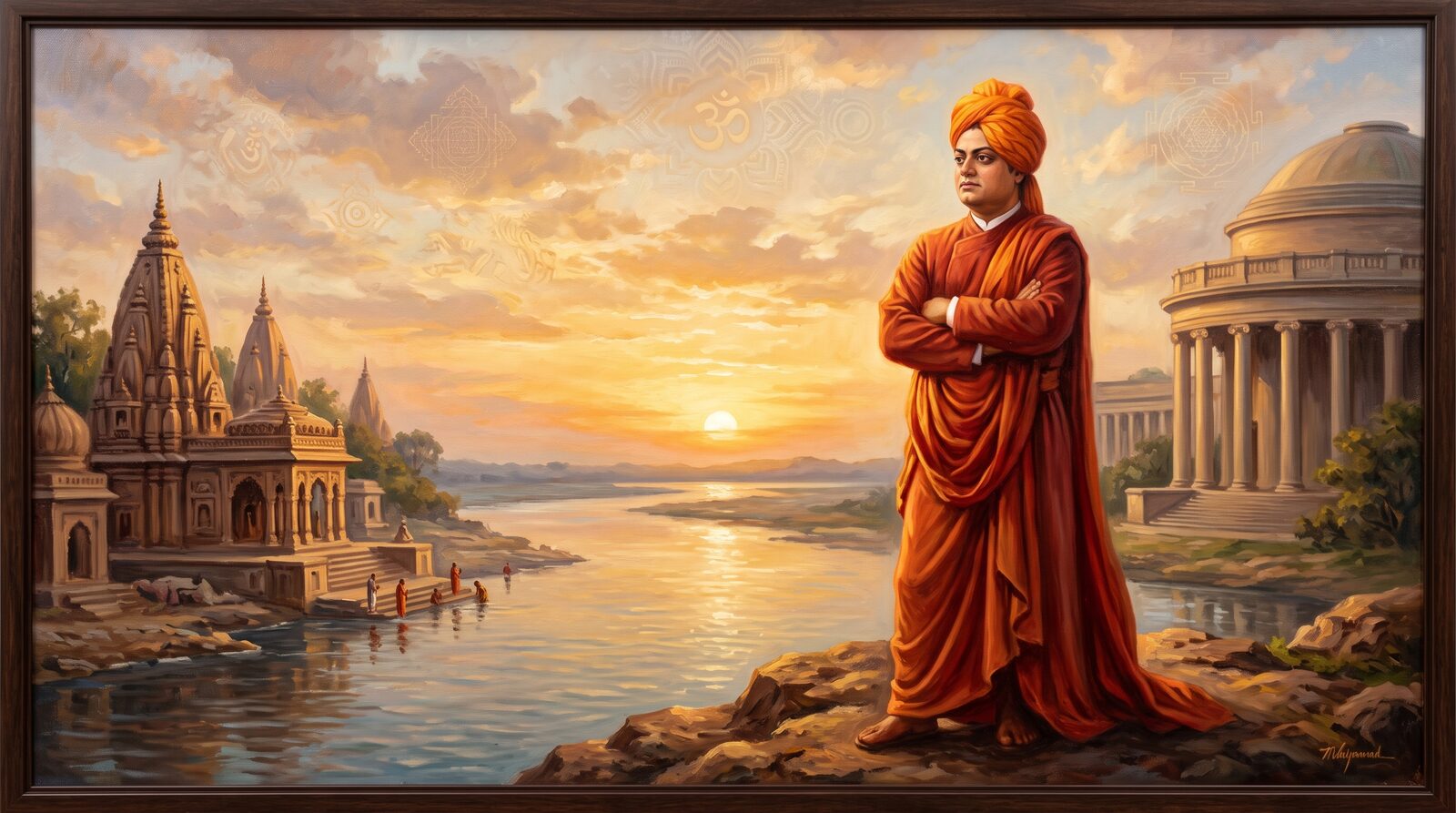
4. The 1893 World’s Parliament of Religions
Vivekananda’s most historically consequential single act was his participation in the World’s Parliament of Religions, held in Chicago in September 1893 as part of the World’s Columbian Exposition. Addressing an American audience largely unfamiliar with Sanatan Dharma thought beyond missionary caricature, Vivekananda opened his remarks with the address “Sisters and Brothers of America,” a greeting reported to have drawn a lengthy standing ovation, and went on to present Vedanta as a universal philosophy of religious tolerance, quoting the principle that as different streams having their sources in different places all mingle their waters in the sea, so the different paths that people take, through different tendencies, all lead to God — a formulation drawing on Ramakrishna’s own teaching of the harmony of religions, translated by Vivekananda into a philosophically framed, Vedanta-grounded universalism suited to an international, interfaith stage. Following the Parliament, Vivekananda spent several years touring and lecturing across the United States and Britain, founding Vedanta Societies in several American cities, before returning to India in 1897 to found the Ramakrishna Mission, an organization combining monastic spiritual practice with organized social service — schools, hospitals, and disaster relief — a structural innovation directly reflecting Practical Vedanta’s fusion of contemplative and social action.
5. Scholarly assessment and critique
Modern academic scholarship on Vivekananda generally credits him with successfully repositioning Sanatan Dharma, for the first time on a global stage, as a confident, rationally defensible, universally applicable philosophy rather than a colonized subject of Orientalist curiosity or missionary condescension, a point emphasized across the Neo-Vedanta literature already cited. At the same time, scholars such as Wilhelm Halbfass (1988) and others working in the broader field of comparative religion have also noted, without diminishing Vivekananda’s significance, that Neo-Vedanta’s confident claim to be the single, tolerant, all-encompassing philosophical summit beneath which all world religions could be subsumed is itself a distinctively modern, and specifically 19th-century, intellectual move — shaped as much by Vivekananda’s engagement with contemporary Western philosophy, Unitarianism, and comparative religious scholarship as by any single classical Sanskrit text, and worth recognizing as an important act of creative modern reinterpretation rather than a simple, unmediated recovery of ancient doctrine. This scholarly point is offered not to diminish Vivekananda’s importance but to place him accurately: not as a passive transmitter of a fixed ancient teaching, but as one of Sanatan Dharma’s most consequential modern re-interpreters, in the same broad tradition of active philosophical renewal as Shankara, Ramanuja, and Madhva before him.
6. Historical context, evidence, and interpretation
The subject of Swami Vivekananda: Reimagining Vedic and Vedantic Thought for the Modern World needs to be approached at more than one level. A religious tradition is not only a collection of doctrines; it is also a record of texts, institutions, practices, places, memories, and changing interpretations. The same word may carry different meanings in different centuries, and the same institution may change while retaining its name. For that reason, the discussion in this chapter distinguishes, wherever the evidence permits, between what a primary source says, what a later community remembers, and what historians infer from comparing independent evidence. This distinction is especially important when a tradition describes its own origins in sacred or idealized language.
Chronology is another safeguard. Dates in South Asian religious history are often approximate because manuscripts are later than the compositions they preserve, oral traditions can predate their surviving written forms, and legendary biographies may combine historical memory with theological purpose. A date attached to a text should therefore not automatically be treated as the date when every idea in that text first existed. Conversely, uncertainty about an exact date does not make a source useless. Linguistic change, intertextual references, material culture, inscriptions, manuscript relationships, and the geographical distribution of traditions can all help establish relative sequence. The result is a history that sometimes has to use ranges and probabilities rather than false precision.
Regional diversity is equally significant. Sanatan Dharma traditions developed across languages and political regions, and religious vocabulary moved between Sanskrit, Prakrits, Tamil, Kannada, Telugu, Bengali, Marathi, Hindi, Gujarati, and many other languages. A practice described in a Sanskrit normative text may not have been followed in the same form by every community. Conversely, a practice absent from a particular Sanskrit text may be important in a local tradition. Historians therefore compare textual sources with inscriptions, temple records, poetry, ritual manuals, oral histories, archaeology, and ethnography when those sources are available. This approach avoids treating elite textual traditions as a complete record of ordinary religious life.
The chapter's topic also demonstrates why the categories used in modern scholarship should be handled carefully. Terms such as “Sanatan Dharma,” “sect,” “orthodox,” “reform,” “tradition,” “modern,” and “folk” are analytical tools, not neutral labels that existed in exactly their present meanings throughout history. A community may understand itself through lineage, deity, village, language, caste, monastic order, philosophical school, or several of these at once. Modern institutions can preserve older practices while introducing new organizational forms, technologies, educational programs, or global networks. Describing such developments as either pure continuity or complete rupture usually misses the more interesting historical process of selective adaptation.
Primary sources deserve particular attention because they constrain what can responsibly be said. Where the chapter discusses a scripture, the strongest evidence is the text itself in a reliable critical or scholarly translation. Where it discusses an institution, inscriptions, legal records, institutional constitutions, archival documents, court records, or contemporary statements can be more probative than later summaries. Secondary scholarship remains indispensable for chronology, context, translation, and historiographical disagreement, but it should be possible for a reader to trace important claims back toward the underlying evidence. Where evidence is disputed, the text should identify the disagreement rather than manufacture certainty.
Finally, interpretation should remain proportionate to evidence. Similar symbols do not necessarily prove direct historical borrowing; theological similarity does not by itself establish institutional descent; and a later community's claim about antiquity is evidence for that community's self-understanding, not automatically proof of the claimed chronology. These cautions do not diminish the significance of religious traditions. They make the history stronger by allowing sacred claims, scholarly hypotheses, archaeological evidence, and modern institutional narratives to be distinguished rather than conflated. The aim of this chapter, as with the book as a whole, is therefore not to settle every contested question but to give readers enough evidence and context to understand why the questions remain meaningful.
4. Vivekananda in Historical Context
Vivekananda's importance lies partly in the fact that he translated selected Vedantic ideas into a modern language of universal religion, social service, strength, education, and national regeneration. His famous appearance at the 1893 World's Parliament of Religions became an important element in the later global memory of Sanatan Dharma, but his thought cannot be understood solely through that event. Scholarship emphasizes his effort to construct a new Sanatan Dharma identity and to connect spiritual ideas with organized charitable work.
At the same time, scholars disagree about how best to characterize his intellectual project. Older scholarship sometimes classified Vivekananda as a “Neo-Vedantin,” implying that modern Vedanta was substantially a Westernized reconstruction. More recent work argues for a more nuanced cosmopolitan interpretation in which Vivekananda drew on indigenous philosophical traditions while responding creatively to colonial modernity and global intellectual exchange. This debate is not merely terminological. It affects how readers understand the relationship between continuity and innovation in modern Sanatan Dharma thought.
Vivekananda also needs to be read critically. His universalist rhetoric could coexist with hierarchical judgments about religions and civilizations, and his writings on caste, social reform, nation, and religious identity have been interpreted in different ways by later scholars and political movements. A responsible account therefore presents both his constructive institutional legacy and the tensions within his thought rather than turning him into either an uncomplicated saint or a purely political ideologue.
5. Universalism, Nationalism, and Selective Tradition
Vivekananda's thought became influential partly because it offered a vocabulary capable of speaking simultaneously to Indian audiences concerned with colonial subordination and international audiences interested in comparative religion. His use of Vedanta, yoga, service, and universal religion helped create a modern presentation of Sanatan Dharma thought that could operate in lecture halls, newspapers, reform organizations, educational institutions, and later global religious movements.
Yet universalism in Vivekananda should not be mistaken for an absence of hierarchy or politics. Torkel Brekke's analysis emphasizes that Vivekananda sought national solidarity and uplift while also making claims about the relative status of different religions. This is important because modern Sanatan Dharma discourse sometimes selectively quotes his statements about tolerance while ignoring the political and comparative-religious context in which they were made.
Later organizations also interpreted Vivekananda differently. Some emphasized Advaita philosophy; others emphasized social service; still others highlighted nationalism, education, youth development, interfaith dialogue, or yoga. His legacy is therefore not a single doctrine but a field of interpretation. A historically grounded chapter should distinguish Vivekananda's own writings from the uses later institutions and political movements have made of them.
6. Evidence, Terminology, and Responsible Interpretation
Several methodological principles help prevent overstatement. First, terminology must be historically situated. Words such as “Sanatan Dharma,” “sect,” “folk,” “tribal,” “orthodox,” “reform,” and “modern” have different meanings in different contexts. Applying a contemporary category to a much earlier community can create the illusion of continuity where the evidence actually shows a change in identity or institution. Second, religious traditions should not be represented solely through elite texts. Archaeology, inscriptions, regional literature, temple records, biographies, oral traditions, and ethnographic research can reveal dimensions of religious life that normative Sanskrit texts do not record.
Third, similarities should be described cautiously. A shared ritual form, deity name, symbol, or philosophical idea may result from direct borrowing, common inheritance, independent development, or later reinterpretation. Establishing influence requires chronological plausibility and some evidence of transmission. This is particularly important when discussing connections between local traditions and pan-Indian deities, between Sanatan Dharma and Islamic traditions, or between ancient and modern institutions.
Finally, uncertainty should be treated as information rather than a weakness. A historical account becomes more trustworthy when it tells readers what is known, what is probable, what is disputed, and what belongs primarily to sacred tradition. The purpose of a research-oriented portal is not to eliminate religious meaning but to keep different kinds of claims intelligible. Where the evidence cannot establish a precise conclusion, the chapter should say so explicitly. That standard will be applied consistently throughout the remaining chapters.
Vivekananda in his own words: Practical Vedanta, Bhakti and service
Swami Vivekananda should be read from his own lectures and writings before being placed inside later academic categories such as 'Neo-Vedanta.' His discussion of Vedanta presents multiple Indian philosophical schools as part of a long argument about the nature of reality, while his lectures on Bhakti and Jnana connect philosophical reflection to lived practice. The Complete Works also makes clear that his project was not limited to his famous Chicago address: he wrote and spoke extensively on yoga, devotion, practical spirituality, education and social service.
His interpretation of Vedanta is distinctive in its insistence that realization should have consequences for human life. The ideal of service becomes connected to the recognition of the divine in human beings. This is one reason the Ramakrishna Mission's institutional history cannot be separated from Vivekananda's philosophical interpretation. Belur Math became a place where monastic discipline, worship, education, relief and service were brought into one organizational framework.
Vivekananda also deserves to be read alongside Indian thinkers who came before and after him. He was shaped by Sri Ramakrishna, engaged with Advaita and other Vedantic schools, and later influenced modern interpreters of Indian philosophy. His thought should therefore be presented neither as a Western invention of Indian religion nor as an unchanged repetition of Shankara. It is a modern Indian reconstruction of Vedanta with its own ethical and institutional consequences.
Indian-source reading trail: Swami Vivekananda, The Vedanta Philosophy, Swami Vivekananda, Complete Works, S. Radhakrishnan, Indian Philosophy, Vol. 1, Swami Ranganathananda, The Message of the Upanishads.
References cited in this chapter
Clickable scholarly, primary, institutional, and documented traditional sources named or used in this chapter.