Chapter 2: The Vedic Age and the Four Vedas (c. 1500–500 BCE)
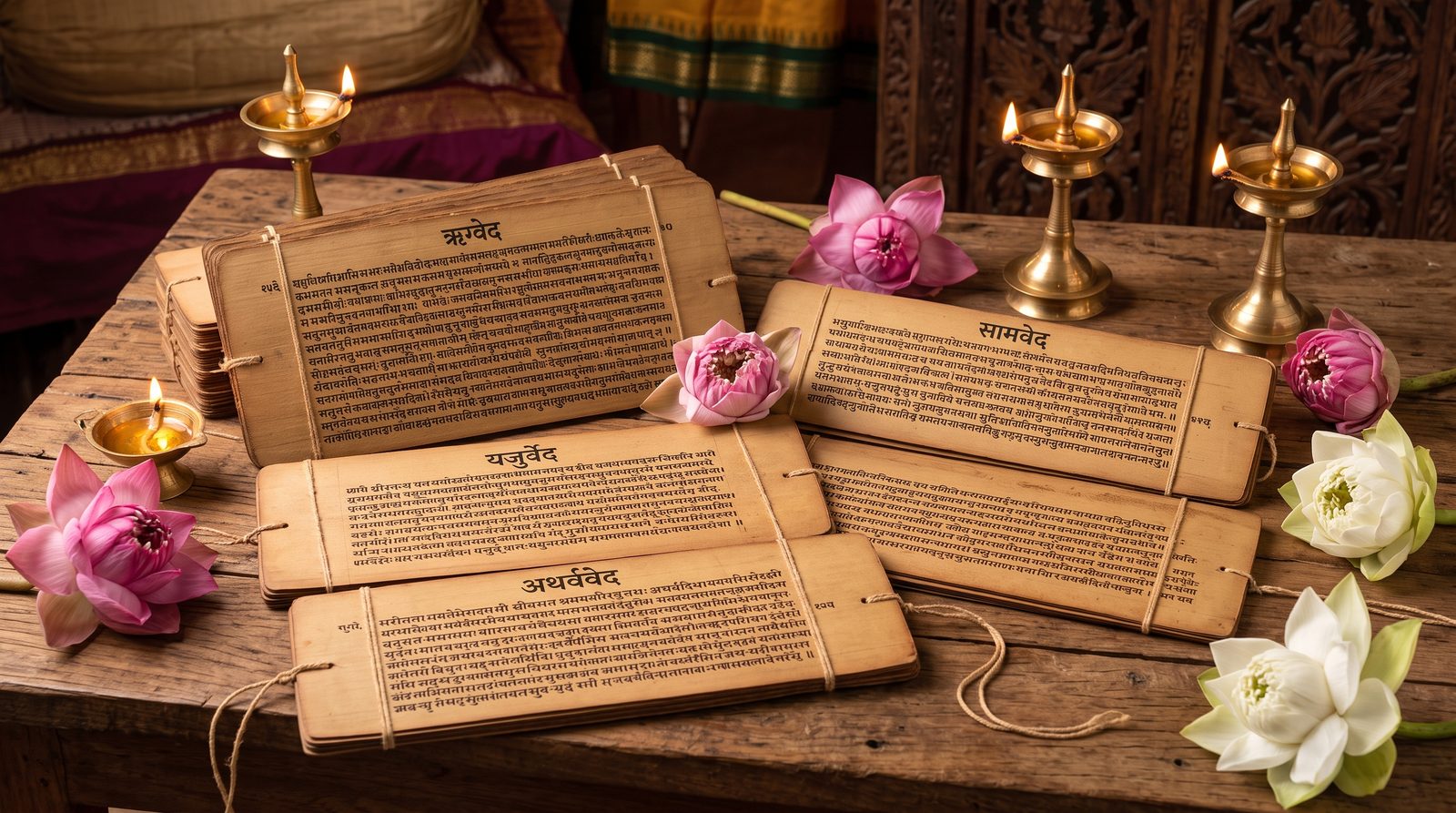
The word “Veda” means knowledge, from the root vid, to know. The Vedas are considered shruti, “that which is heard” — an eternal, revealed body of knowledge perceived by ancient seers (rishis), in contrast to smriti, “that which is remembered,” the later tradition of epics, law codes, and Puranas. There are four Vedas.
Enlightenment mantras: from darkness to light
The Vedic and Upanishadic inheritance also expresses spiritual transformation through concise mantras. The best-known formulation is:
ॐ असतो मा सद्गमय ।
तमसो मा ज्योतिर्गमय ।
मृत्योर्मा अमृतं गमय ।Om asato mā sadgamaya; tamaso mā jyotirgamaya; mṛtyor mā amṛtaṃ gamaya.
“Lead me from the unreal to the real; from darkness to light; from mortality to immortality.” In the Bṛhadāraṇyaka Upanishad 1.3.28, these lines express a movement from limitation and ignorance toward truth, illumination, and liberation. The mantra is therefore a useful opening key for the book: knowledge is not merely information, but a transformation of how reality and the self are understood.
Alongside it stand other foundational formulations: sarvaṃ khalvidaṃ brahma (“all this is Brahman”), tat tvam asi (“that thou art”), and the Vedic aspiration that people may move together in shared purpose. These passages should not be collapsed into one doctrine, but together they show why later Sanatan Dharma philosophies repeatedly return to consciousness, unity, ethical responsibility, and liberation.
Primary textual anchor: Bṛhadāraṇyaka Upanishad 1.3.28. Text and translation.
1. Rigveda (c. 1500–1200 BCE)
The oldest and most important Veda, a collection of 1,028 hymns (suktas) in ten books (mandalas), addressed chiefly to nature deities: Agni, Indra, Varuna, Soma, Ushas, and others (Doniger O’Flaherty, 1981, The Rig Veda: An Anthology, provides an accessible annotated translation of 108 of these hymns). Book 10 contains the Purusha Sukta, describing creation through the sacrifice of a cosmic being, later used to justify the four-fold varna order, and the Nasadiya Sukta (“Hymn of Creation”), an agnostic meditation on origins.
2. Samaveda, Yajurveda, Atharvaveda
The Samaveda sets Rigvedic verses to melody for the soma sacrifice and is the acknowledged root of Indian classical music. The Yajurveda supplies the liturgical formulas priests used to perform sacrifice, in two recensions, the “Black” (Krishna) and “White” (Shukla) Yajurveda. The Atharvaveda, the latest and most eclectic, contains hymns of healing, protection, and domestic ritual, closer to popular religion than the other three (Whitney’s classic translation, 1905, remains a standard reference).
3. How the four Vedas function as a textual corpus
The four Vedas should not be imagined as four modern books written at one time by four authors. Each is a layered corpus transmitted orally through highly controlled schools. The Vedic tradition preserved words, accents, sequences, and ritual associations with extraordinary precision, while different shakhas, or branches, maintained their own recensions. What survives today is therefore the result of a long history of composition, redaction, memorization, and transmission. The word “Veda” can refer both to a particular textual collection and, more broadly, to authoritative sacred knowledge.
The Rigveda is primarily a collection of poetic hymns used within sacrificial culture. Its gods are not merely personifications of natural forces; they participate in a world of reciprocity, patronage, praise, competition, and ritual exchange. Agni carries offerings, Indra defeats enemies and releases waters, Soma is both a ritual substance and a divine presence, and dawn is praised as a recurring renewal. The hymns also reveal that early Vedic religion was not a simple system of abstract philosophy. It was embedded in social relationships among patrons, priests, poets, households, and chiefs.
The Samaveda demonstrates another important feature of Vedic religion: the transformation of inherited poetry through performance. Most of its verses are drawn from the Rigveda, but they are arranged and musically adapted for the soma sacrifice. The Yajurveda is more directly concerned with the formulas and procedural knowledge needed by the ritual specialist. Its two major textual families, the Krishna and Shukla Yajurveda, preserve different arrangements of prose and mantra material. The Atharvaveda broadens the picture further by preserving material concerned with healing, protection, household concerns, royal rites, and other practices that do not fit neatly into the public soma-sacrifice paradigm.
These differences are historically significant. They show that “Vedic religion” was never a single flat set of beliefs. It was a family of ritual and textual traditions that developed over time and were subsequently reinterpreted by Brahmanas, Aranyakas, Upanishads, Sutras, epics, Puranas, and later sectarian traditions. Reading the Vedas historically therefore requires attention to genre, chronology, transmission, and ritual setting rather than extracting isolated verses and treating them as timeless statements of Sanatan Dharma doctrine.
Further sources: Jamison and Brereton, The Rigveda (2014); Witzel (1995); Doniger O’Flaherty, The Rig Veda: An Anthology (1981); Whitney, Atharva-Veda Samhita (1905).
5. The Rigveda as poetry, ritual and historical evidence
The Rigveda should not be approached simply as a chronological narrative of ancient India. It is a collection of hymns composed for ritual and poetic performance. The modern critical understanding of the text is therefore inseparable from its language, meter, poetic conventions and ritual setting. Stephanie Jamison and Joel Brereton describe it as a corpus of more than one thousand hymns whose poems address divinities, ritual actions, cosmic questions and human concerns. Their work also emphasizes that the text has a complicated history of composition and collection. Jamison and Brereton, The Rigveda, Oxford University Press.
This matters for chronology. A date assigned to the surviving canonical arrangement is not necessarily the date of composition of every hymn. Different hymns can preserve different linguistic and cultural layers, while the collection itself reflects later editorial organization. The safest formulation is consequently to discuss the Rigveda as a body of early Vedic poetry situated broadly in the second millennium BCE, while acknowledging that exact dates for individual compositions remain debated.

6. The other three Vedas and their relationship to ritual
The Sāmaveda, Yajurveda and Atharvaveda should not be treated as three independent “Bibles” competing with the Rigveda. They represent different functions within a larger Vedic ritual and liturgical tradition. The Sāmaveda is strongly associated with melodies and the sung performance of verses, many of which are also found in the Rigveda. The Yajurvedic traditions preserve formulas and ritual instructions associated with sacrificial performance and exist in major Śukla and Kṛṣṇa recensional traditions. The Atharvaveda preserves a different collection of spells, prayers and ritual materials, expanding the picture of Vedic religious life beyond the great public sacrifices.
The existence of multiple recensions is itself historically important. Vedic learning was maintained through disciplined oral transmission, with schools preserving their own textual traditions. The fact that the corpus was transmitted orally for centuries does not make it historically unusable; rather, it requires scholars to distinguish the history of composition, transmission and later canonization. Modern philological editions and translations are therefore indispensable for readers who cannot work directly with Vedic Sanskrit.
4. Historical context, evidence, and interpretation
The subject of The Vedic Age and the Four Vedas (c. 1500–500 BCE) needs to be approached at more than one level. A religious tradition is not only a collection of doctrines; it is also a record of texts, institutions, practices, places, memories, and changing interpretations. The same word may carry different meanings in different centuries, and the same institution may change while retaining its name. For that reason, the discussion in this chapter distinguishes, wherever the evidence permits, between what a primary source says, what a later community remembers, and what historians infer from comparing independent evidence. This distinction is especially important when a tradition describes its own origins in sacred or idealized language.
Chronology is another safeguard. Dates in South Asian religious history are often approximate because manuscripts are later than the compositions they preserve, oral traditions can predate their surviving written forms, and legendary biographies may combine historical memory with theological purpose. A date attached to a text should therefore not automatically be treated as the date when every idea in that text first existed. Conversely, uncertainty about an exact date does not make a source useless. Linguistic change, intertextual references, material culture, inscriptions, manuscript relationships, and the geographical distribution of traditions can all help establish relative sequence. The result is a history that sometimes has to use ranges and probabilities rather than false precision.
Regional diversity is equally significant. Sanatan Dharma traditions developed across languages and political regions, and religious vocabulary moved between Sanskrit, Prakrits, Tamil, Kannada, Telugu, Bengali, Marathi, Hindi, Gujarati, and many other languages. A practice described in a Sanskrit normative text may not have been followed in the same form by every community. Conversely, a practice absent from a particular Sanskrit text may be important in a local tradition. Historians therefore compare textual sources with inscriptions, temple records, poetry, ritual manuals, oral histories, archaeology, and ethnography when those sources are available. This approach avoids treating elite textual traditions as a complete record of ordinary religious life.
The chapter's topic also demonstrates why the categories used in modern scholarship should be handled carefully. Terms such as “Sanatan Dharma,” “sect,” “orthodox,” “reform,” “tradition,” “modern,” and “folk” are analytical tools, not neutral labels that existed in exactly their present meanings throughout history. A community may understand itself through lineage, deity, village, language, caste, monastic order, philosophical school, or several of these at once. Modern institutions can preserve older practices while introducing new organizational forms, technologies, educational programs, or global networks. Describing such developments as either pure continuity or complete rupture usually misses the more interesting historical process of selective adaptation.
Primary sources deserve particular attention because they constrain what can responsibly be said. Where the chapter discusses a scripture, the strongest evidence is the text itself in a reliable critical or scholarly translation. Where it discusses an institution, inscriptions, legal records, institutional constitutions, archival documents, court records, or contemporary statements can be more probative than later summaries. Secondary scholarship remains indispensable for chronology, context, translation, and historiographical disagreement, but it should be possible for a reader to trace important claims back toward the underlying evidence. Where evidence is disputed, the text should identify the disagreement rather than manufacture certainty.
Finally, interpretation should remain proportionate to evidence. Similar symbols do not necessarily prove direct historical borrowing; theological similarity does not by itself establish institutional descent; and a later community's claim about antiquity is evidence for that community's self-understanding, not automatically proof of the claimed chronology. These cautions do not diminish the significance of religious traditions. They make the history stronger by allowing sacred claims, scholarly hypotheses, archaeological evidence, and modern institutional narratives to be distinguished rather than conflated. The aim of this chapter, as with the book as a whole, is therefore not to settle every contested question but to give readers enough evidence and context to understand why the questions remain meaningful.
The Vedic corpus as a layered historical archive
The four Vedas are not four books produced at one moment. The Rigveda preserves an early collection of hymns; the Samaveda reorganizes verses largely for liturgical singing; the Yajurveda contains prose and verse materials associated with sacrificial performance in several recensions; and the Atharvaveda contains a distinctive mixture of charms, prayers, healing-related material and ritual concerns. Within the wider Vedic corpus, Brahmanas, Aranyakas and Upanishads represent further developments in ritual interpretation, speculation and philosophical inquiry. The history of “the Vedas” is consequently a history of textual layers, schools and transmission practices rather than a single publication event. [Flood 2020]
Oral transmission is central to this history. Vedic recitation developed elaborate techniques for preserving phonetic sequences, accents and word order. That achievement should not be romanticized into the claim that every later interpretation is equally ancient, but it does show that textual preservation in ancient India could operate through highly disciplined oral institutions. A surviving manuscript is therefore not necessarily the origin of the text it records. Historical dating must distinguish composition, redaction, oral transmission and manuscript preservation.
The Vedic world was also not identical to later Sanatan Dharma in every respect. Ritual sacrifice, priestly specialization and deities prominent in the early hymns occupy a different religious landscape from later temple-centered worship, image devotion and sectarian theologies. Yet later Sanatan Dharma traditions repeatedly reread Vedic authority. Some schools interpreted later practices as developments of Vedic principles; reformers invoked the Vedas to criticize practices they considered later accretions; and philosophical traditions claimed continuity with Vedic revelation while disagreeing sharply about its meaning. The historical importance of the Vedas therefore lies both in their early religious world and in their continuing role as a source of authority and reinterpretation.
References cited in this chapter
Clickable scholarly, primary, institutional, and documented traditional sources named or used in this chapter.