Revenue, Treasury and Public Finance
Research basis: Primary-text interpretation follows the supplied study and the scholarly translation tradition; see the bibliography and source notes.
The Arthaśāstra gives the treasury a central place because political intentions require material resources. Revenue supports administration, security, military operations and responses to crisis. The supplied study connects taxation, fines, tolls, state enterprises, natural resources and crown lands with the broader problem of preserving the fiscal base. This is not a modern public-finance system, but it is a sophisticated ancient discussion of how a government obtains and manages resources.
A crucial theme is the relationship between extraction and production. A ruler can increase immediate revenue by imposing heavy burdens, but if those burdens reduce cultivation, trade or settlement, the future base can shrink. The text’s famous imagery about collecting revenue without damaging the source captures this general principle. It should not be converted into a precise modern tax-rate rule. Its analytical point is that a government depends on the continued productivity of the people and territory from which it derives resources.
The treasury is also a reserve. Funds are needed not only for ordinary expenditure but for shocks such as war, famine and other calamities. This makes liquidity and storage strategic concerns. Modern governments express the same problem through contingency reserves, emergency appropriations, stabilization mechanisms and fiscal planning, although their legal and economic frameworks are entirely different. The analogy is therefore strongest at the level of resilience rather than policy prescription.
The text’s attention to accounting is equally significant. Revenue is meaningful only if it can be measured, collected and protected from leakage. Registers, receipts, inspections and supervisory procedures appear as part of the administrative environment. Corruption is treated as a structural risk created by discretion and access to resources. The appropriate institutional response is monitoring rather than an assumption that every official will behave perfectly.
This can be represented as a cycle: production creates the taxable and economic base; assessment determines obligations; collection converts activity into public revenue; the treasury stores and allocates resources; expenditure maintains administration and capacity; reserves provide resilience; and effective public spending can in turn protect production. The figure in this edition is an original analytical diagram, not a reconstruction of an ancient accounting chart.
The modern lesson is best framed as fiscal sustainability. Leaders should ask whether current extraction undermines future capacity, whether spending creates durable institutional value, whether reserves are sufficient for foreseeable shocks, and whether financial information is independently verifiable. These questions apply to governments, nonprofits and businesses, but the institutional rules differ.
The text nevertheless has significant limits. Its fiscal logic serves a monarchy seeking revenue and strategic capacity. Modern taxation must operate under constitutional rules, democratic authorization and legal protections. A modern state cannot simply adopt ancient forms of compulsory extraction because the ancient text discusses them. The appropriate use of the Arthaśāstra is therefore comparative: it offers a historical example of thinking about revenue as part of a larger system of production, legitimacy, administration and security.
Figure 2. Original analytical illustration of the revenue/state-capacity cycle.
Approximate chapter body word count: 477.
Expanded Research Discussion
Expanded research discussion: Chapter 7
The subject of this chapter is best understood within the larger structure of the Arthaśāstra. The work repeatedly connects authority, resources, information, administration, law, security and external relations. A detailed discussion therefore has to consider not only the individual rule or category but also the institutional problem that the category addresses. This approach avoids reducing the treatise to a list of quotations and helps explain why apparently different sections of the work speak to related questions of capacity and survival.
The first distinction is between prescription and historical description. The received text is a normative and analytical work. When it gives a rule for an official, a ruler, a court, a market, a treasury or a military operation, that rule establishes what the text recommends or discusses. It does not automatically demonstrate that every such rule was implemented everywhere. Nor does it establish that the political institutions of the period were uniform. A responsible history therefore uses formulations such as “the text prescribes,” “the treatise discusses,” or “the authorial tradition presents,” unless independent evidence supports a stronger claim.
The second distinction concerns textual formation. Modern scholarship has treated authorship, dating, organization and redaction as questions requiring evidence. Kangle’s critical edition and translation established an important modern foundation for studying the Sanskrit text. Trautmann used statistical methods to investigate authorship and textual evolution. Olivelle provided a major annotated translation together with discussion of structure, composition and historical setting. McClish has further examined the history of the text and the relationship among statecraft, law and sacred tradition. These works do not eliminate disagreement; rather, they demonstrate why disagreement should be reported instead of concealed.
The third distinction concerns translation. A Sanskrit technical term may have a range of meanings that cannot be reproduced perfectly by one English word. Terms connected with law, punishment, officials, territory, treasury, alliance or strategy can therefore acquire misleading modern associations. Comparing translations is not a decorative exercise. It is a way of identifying where interpretation enters the English text. Where a conclusion depends heavily on a particular rendering, the reader should consult the underlying Sanskrit and scholarly notes.
Within that source-critical framework, the chapter raises a broader institutional problem: how a political organization can pursue objectives while maintaining the resources, information and administrative capacity required to continue operating. This is a recurring concern across the treatise. Material resources are useful only when they can be collected, protected and deployed. Officials are useful only when their responsibilities are clear and their conduct can be supervised. Intelligence is useful only when reports can be assessed for reliability. Alliances are useful only when their changing interests are understood. Strategy is useful only when it is adapted to circumstances rather than treated as a fixed formula.
This systems perspective is one of the legitimate reasons the Arthaśāstra can be studied today. A modern reader may translate the ancient problem into a contemporary question: What capacities must an institution maintain if it wants to achieve a long-term objective? That question can be applied to public administration, business, nonprofit management or organizational leadership. The modern question, however, is a new formulation. It should not be presented as evidence that the ancient author was writing a modern management textbook.
Another recurring theme is the relationship between immediate gain and long-term capacity. Institutions can weaken themselves by extracting too much from the productive base on which future activity depends. Public authorities may face a relationship between revenue and production. Organizations may face a relationship between cost reduction and capability. Strategic actors may face a relationship between immediate advantage and the resources required to sustain that advantage. The analogy is useful because it encourages analysis of feedback and second-order effects, but the institutional contexts remain different.
Information presents a similar problem. Decision makers rarely observe every event directly. They depend on reports, intermediaries and records. Those channels can introduce error, delay, bias or deliberate distortion. The Arthaśāstra’s concern with supervision, verification and intelligence can therefore be read as an ancient response to a general problem of governance under incomplete information. Modern institutions have additional tools—auditing, statistical analysis, independent oversight, digital records, privacy rules, judicial review and professional standards—but the basic analytical problem remains recognizable.
The same reasoning applies to risk. A system that performs well in ordinary conditions can become fragile when exposed to a shock. Reserves, alternative channels, contingency plans and reliable information can determine whether an institution absorbs disruption or enters a cascade of failures. The ancient text discusses calamities and vulnerabilities in its own conceptual language. Modern risk management uses different methods, including probability, scenario analysis, stress testing and specialized emergency institutions. The useful comparison is therefore about the problem of preparedness, not about claiming identity between the systems.
The chapter should also be read as a study of incentives. Rules are implemented by people whose interests and information may differ from those of the central authority. Formal policy is therefore only part of institutional performance. Monitoring, rewards, penalties, division of responsibilities and records can change behavior. Modern organizations add conflict-of-interest rules, independent oversight, labor protections, due process and transparency requirements. Those modern safeguards are not to be projected backward into the Arthaśāstra; they are part of the contemporary framework that must govern any modern application.
Where the chapter concerns coercion, warfare, hierarchy or secrecy, historical distance becomes especially important. Some mechanisms described in ancient statecraft would not be acceptable under contemporary law or professional ethics. A modern reader should not treat historical description as authorization. The correct method is to identify the problem, describe the historical response, identify the assumptions that made that response intelligible in its original setting, and then consider how a modern institution addresses the analogous problem under current law and ethical standards.
The book therefore uses modern application cautiously. It asks what questions the ancient categories can stimulate rather than pretending that they provide ready-made answers. The most defensible modern use is often diagnostic: mapping dependencies, identifying information bottlenecks, distinguishing essential from nonessential resources, examining incentives, testing assumptions, and preparing for adverse scenarios. These are contemporary analytical practices that happen to resonate with recurring problems visible in the ancient text.
Finally, the research value of the chapter depends on maintaining source discipline. Quotations should be checked against the edition actually used. Sanskrit terms should not be given invented meanings merely because an English translation appears convenient. Historical claims should be distinguished from modern interpretation. Where scholars disagree, the disagreement should remain visible. Where the evidence is incomplete, the appropriate conclusion is uncertainty.
Modern application boundary
The contemporary material in this chapter is an analytical analogy, not a claim that the Arthaśāstra anticipated modern institutions. Ancient political organization, social hierarchy, legal authority and economic life differed substantially from those of a contemporary constitutional state, corporation or nonprofit. Modern readers should therefore use the chapter to formulate questions and analytical models rather than to reproduce ancient institutions.
Source-verification note
The principal scholarly anchors for this edition are Patrick Olivelle, R. P. Kangle, Thomas Trautmann, Mark McClish and I. W. Mabbett, supplemented by L. N. Rangarajan and R. Shamasastry for translation and reception history. Exact page references vary by edition; this edition therefore avoids fabricated pagination. Before formal publication, claims intended as quotations or close textual analysis should be checked against the precise edition and passage cited.
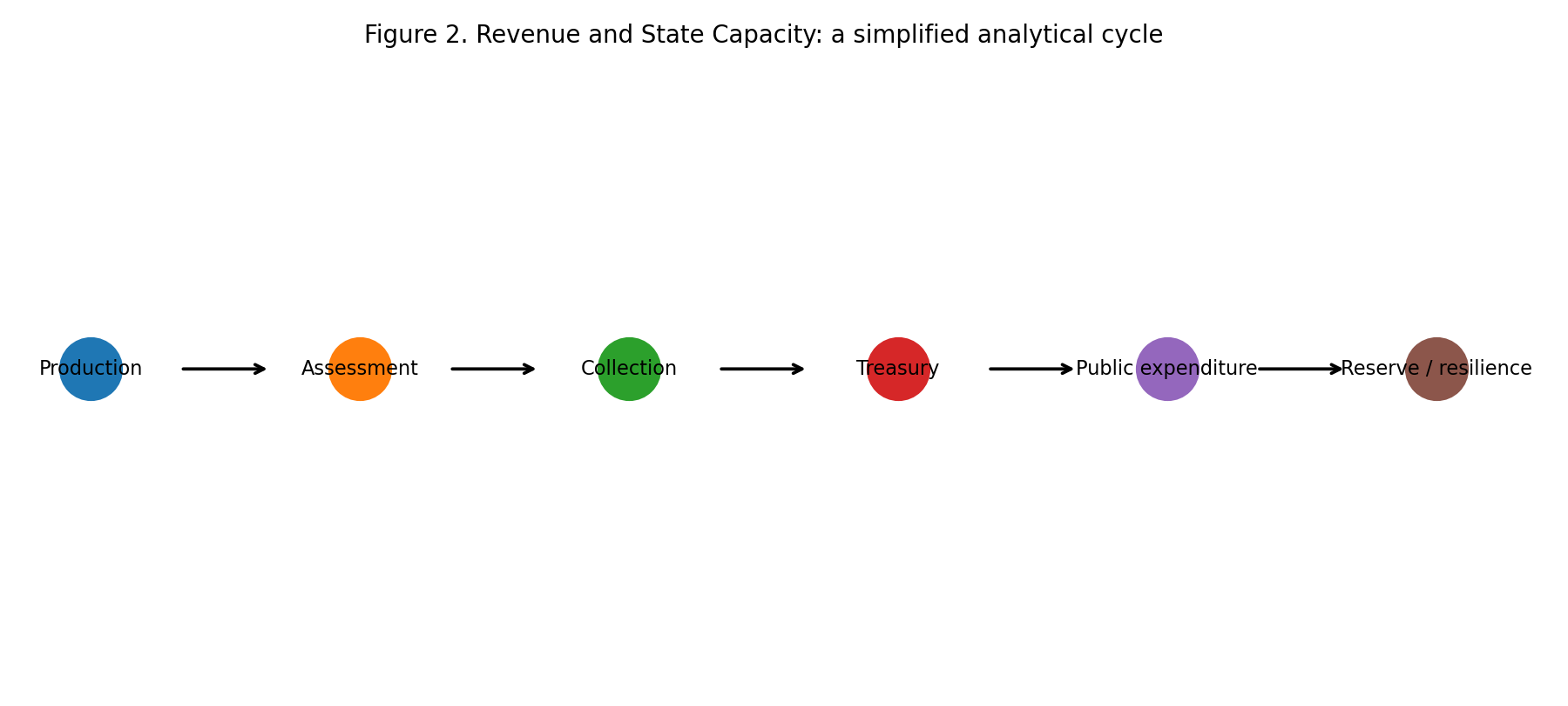
Figure: Revenue and state-capacity feedback model.
Approximate chapter text: 1,735 words