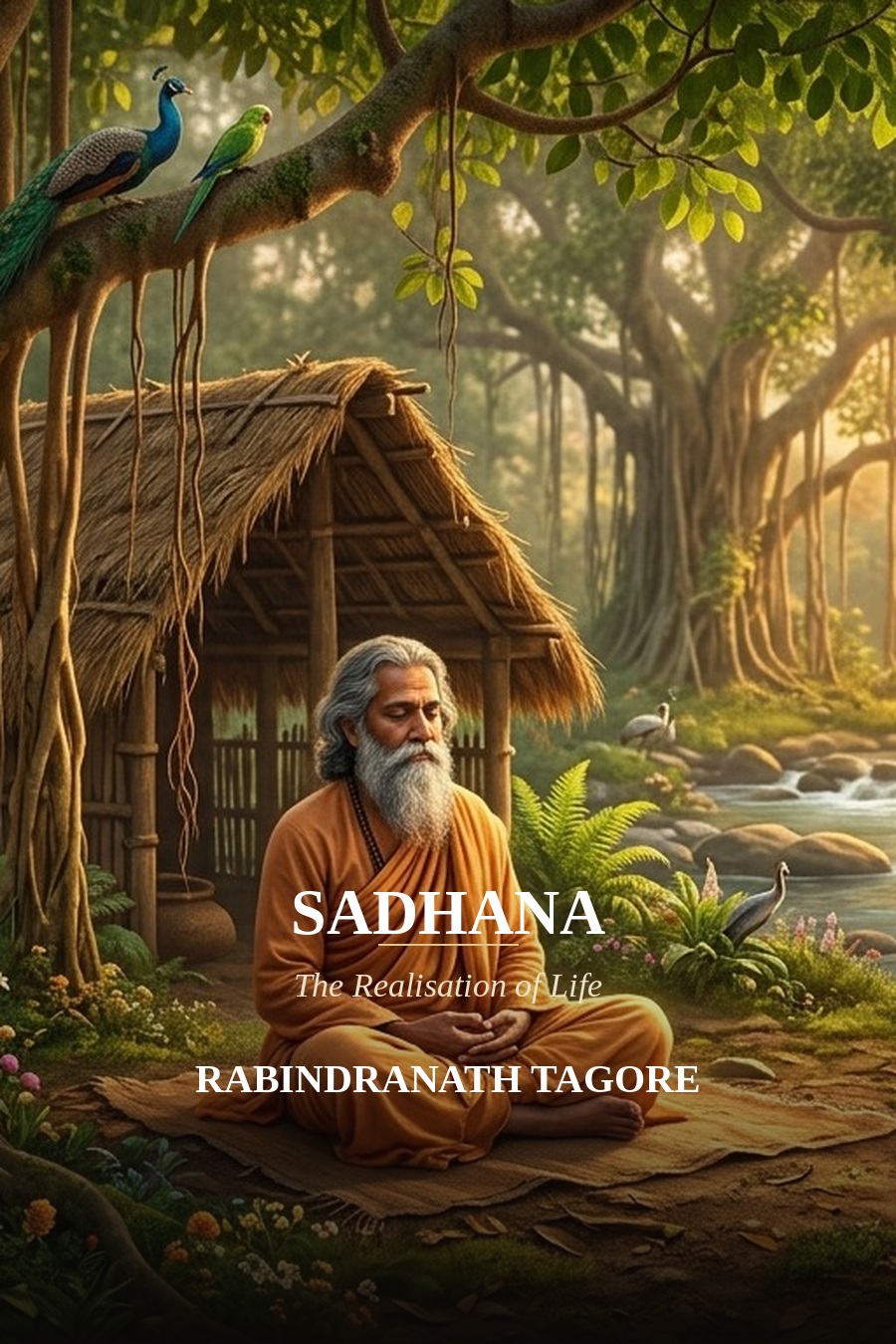
Sadhana: The Realisation of Life
Eight lectures Tagore delivered in English at Harvard and elsewhere, distilling the Upanishadic vision he was raised on into a meditation on the individual's relation to the universe, the soul, love, beauty, evil and the infinite — a compact, lyrical companion to the more devotional texts in this library.
Public-domain 1916 text (Project Gutenberg eBook #6842), reformatted for this site's reading layout. View the original, unmodified Project Gutenberg edition ↗
Book Summary
Delivered as English lectures to Western audiences at Harvard and elsewhere in 1913, Sadhana sets out the outlook Tagore says he absorbed simply by growing up steeped in the Upanishads — not as a system of doctrines but as a way of living tuned to what he calls the joy pervading the universe. Its opening essays, "The Relation of the Individual to the Universe" and "Soul-Consciousness," argue that India's forest-dwelling sages built an entire culture around the discovery that the self is never truly separate from the world around it, and that freedom comes from realizing this kinship rather than from either indulging or renouncing the world.
From there Tagore works through what he treats as the tradition's hardest questions. "The Problem of Evil" reframes suffering and imperfection not as a flaw in creation but as friction that appears only when things are seen in isolation from the whole, dissolving once seen from the standpoint of the infinite. "The Problem of Self" takes up the paradox that the very ego capable of feeling separate is also the vehicle through which union with the infinite becomes possible — arguing against pure self-extinction, and for the harder work of the personality freely surrendering itself in love.
The closing essays — "Realisation in Love," "Realisation in Action," "The Realisation of Beauty," and "The Realisation of the Infinite" — turn from argument to description of how this union is actually lived: through love as the highest form of knowledge, through work performed without anxious attachment to its results, through beauty understood as a glimpse of the world's hidden harmony, and finally through a vision of the infinite that is fully present inside ordinary, everyday existence rather than remote from it.
Read as a whole, the eight lectures form one continuous argument moving from metaphysics to ethics to aesthetics — a Bengali poet's felt account of a civilizational idea, that realisation (sadhana) is an active, disciplined pursuit rather than passive belief, and that its goal is not escape from the world but a fuller, more harmonious relationship with it.